LED UV Curing for Pressure Sensitive Adhesive: Revolutionizing Assembly with Energy Efficiency & Fast Cure
In the intricate world of modern manufacturing, where speed, sustainability, and precision are non-negotiable, the adhesive bonding process is undergoing a quiet revolution. At the forefront of this transformation is Light Emitting Diode Ultraviolet (LED UV) curing technology, LED UV curing for Pressure Sensitive Adhesives (PSAs). Moving beyond conventional thermal or mercury-arc UV curing, LED UV curing offers a paradigm shift, delivering unprecedented energy efficiency alongside dramatically fast cure times. This synergy is not merely an incremental improvement but a foundational upgrade that is redefining production lines across industries from electronics and medical devices to automotive and packaging.
Understanding the Components: PSAs and UV Curing
To appreciate the breakthrough, we must first understand the key players.
Pressure Sensitive Adhesives (PSAs): are a unique class of viscoelastic materials that form a bond with a surface upon the application of light pressure. They are ubiquitous, found in labels, tapes, graphic films, and assembly applications for consumer electronics. Traditional PSAs cure via evaporation, heat, or moisture, processes that can be slow, energy-intensive, or require significant floor space for drying tunnels.
UV Curing:in its traditional form, uses ultraviolet light to instantly “set” or cure adhesives, coatings, and inks. These formulations contain photoinitiators—molecules that absorb UV photons and trigger a rapid polymerization reaction, turning the liquid resin into a solid network in seconds. Historically, this was achieved with mercury-vapor lamps.
LED UV Curing:This technology utilizes semiconductor light sources that emit a narrow, intense band of UV light, typically at 365nm, 385nm, or 395nm wavelengths. It is this specific innovation that unlocks the dual advantages of energy efficiency and speed for PSA curing.
The Pillar of Energy Efficiency: A Sustainable Advantage
The energy efficiency of LED UV curing is multi-faceted and profound, representing a major step towards greener manufacturing.
- On-Demand, Instant Operation: Unlike mercury lamps which require a 5-15 minute warm-up and idle at full power, LED systems are instant on/off. They emit full-intensity light the moment they are powered, and consume no energy during product changeovers or line stoppages. This eliminates the massive standby energy waste characteristic of traditional systems.
- Focused Spectral Output: Mercury lamps emit a broad spectrum of light (UV, visible, infrared), but only a small fraction (the UV band) is useful for curing. The rest is wasted as heat and visible light. LED systems, conversely, are engineered to emit almost exclusively at the target wavelength required by the PSA’s photoinitiators. This “cool” curing delivers photons where they are needed, dramatically reducing electrical power consumption—often by 70% or more compared to arc lamps.
- Reduced Thermal Load & HVAC Savings: The infrared (IR) radiation from mercury lamps generates substantial heat. This often necessitates expensive ancillary cooling systems (chillers, exhausts) and increases the load on factory air conditioning. The minimal IR output of LEDs creates a “cold cure” process. This not only saves the energy required for lamp cooling but also reduces the overall HVAC demand, leading to compounded energy savings. It also enables the bonding of heat-sensitive substrates like thin plastics, films, and electronic components without risk of warping or damage.
- Longevity and Reduced Maintenance: LED curing units boast operational lifespans of 20,000 to 30,000 hours, dwarfing the 1,000-2,000 hour lifespan of a typical mercury bulb. This drastically reduces replacement frequency, associated maintenance downtime, and the hazardous waste stream from spent mercury bulbs, which require special disposal procedures.
The Pillar of Fast Cure: Unlocking Production Velocity
Speed is the currency of modern manufacturing, and LED UV curing enriches it significantly.
- Cure in Milliseconds to Seconds: The high-intensity, monochromatic output of LEDs allows for exceptionally fast curing. A bond that might take minutes with a heat-activated PSA or even seconds with a conventional UV lamp can be achieved in a fraction of a second under an LED array. This enables:
- Higher Line Speeds: Production lines can run faster, directly increasing throughput and capacity.
- Immediate Next-Step Processing: Parts can be handled, packaged, or moved to the next assembly step immediately after the curing station, eliminating buffer zones and reducing work-in-progress inventory.
- Just-in-Time Manufacturing: The rapid cure facilitates agile, on-demand production flows.
- Depth of Cure and Through-Cure: Advanced LED UV formulations for PSAs are designed for deep, through-cure rather than just surface tack. The intense, consistent light ensures complete polymerization throughout the adhesive layer, resulting in a durable, high-performance bond with excellent long-term aging properties. This is critical for structural assembly tasks, not just labeling.
- Enhanced Process Control and Consistency: The stable output of LEDs (without the intensity decay of aging mercury bulbs) ensures every product receives an identical UV dose. This eliminates the variability that can lead to under-cured (weak bond) or over-cured (brittle bond) products, enhancing quality control and reducing scrap rates. The instant on/off capability also allows for precise “flash” curing at exact moments, enabling innovative applications like pinpoint bonding.
Synergistic Benefits: Beyond Efficiency and Speed
The combination of these two pillars creates a cascade of additional advantages:
- Space Savings: Compact LED modules eliminate the need for large drying ovens or lamp housings, freeing up valuable factory floor space.
- Design Freedom: The ability to bond heat-sensitive and dissimilar materials (e.g., glass to plastic, metal to circuit boards) opens new avenues for product design.
- Improved Working Environment: The elimination of IR heat and ozone generation (common with medium-pressure mercury lamps) creates a safer, more comfortable workspace for operators.
- 24/7 Readiness: The reliability and instant-on nature of LEDs support continuous and shift-based operations without lag.
Industry Applications: Where the Revolution is Happening
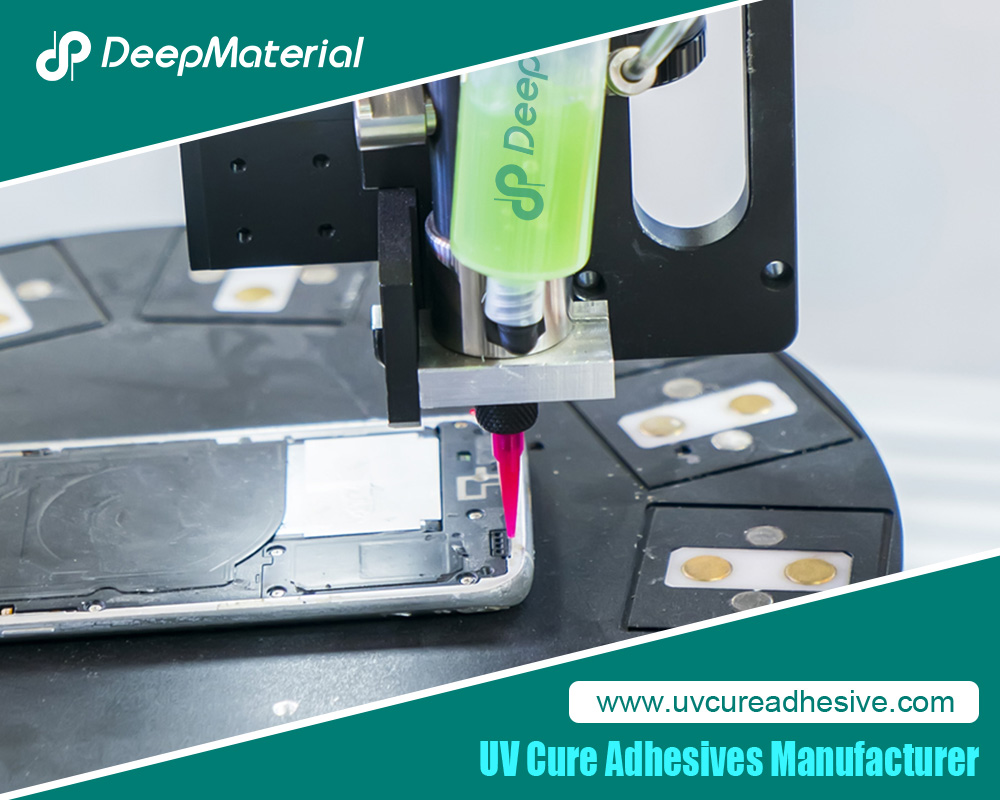
- Electronics Assembly: Bonding display lenses, touch panels, speakers, and components inside smartphones, tablets, and wearables where heat sensitivity is paramount and throughput is extreme.
- Medical Device Manufacturing: Assembly of disposable medical devices, syringe labels, and wound care products, benefiting from clean-room compatibility, no VOCs, and the ability to bond biocompatible materials.
- Automotive: Interior trim assembly, instrument cluster bonding, and application of decorative films and smart labels.
- Packaging & Labeling: High-speed bottle labeling, tamper-evident seals, and premium packaging where instant cure and high bond strength are required.
Comparison at a Glance: LED UV vs. Traditional Methods
| Feature | LED UV Curing | Traditional Mercury UV | Thermal Curing |
| Energy Consumption | Very Low (On-demand) | Very High (Constant) | High (Ovens run continuously) |
| Cure Speed | Milliseconds to Seconds | Seconds | Minutes to Hours |
| Heat Output | Very Low (“Cold Cure”) | Very High (Significant IR) | Extremely High |
| Start-up Time | Instant (0 seconds) | Slow (5-15 min warm-up) | Slow (Oven heat-up) |
| Lamp Life | 20,000 – 30,000 hrs | 1,000 – 2,000 hrs | N/A (Heating Elements) |
| Process Footprint | Very Compact | Large | Very Large (Oven/Tunnel) |
| Suitable Substrates | All, including heat-sensitive | Most (heat risk) | Heat-resistant only |
Conclusion
LED UV curing for Pressure Sensitive Adhesives is more than just a new tool; it is a strategic manufacturing technology that aligns perfectly with 21st-century imperatives. It masterfully addresses the dual challenge of reducing environmental impact while accelerating production. The dramatic energy savings slash operational costs and carbon footprints. The blistering cure speeds unlock new levels of productivity and process flexibility.
As formulations continue to advance, matching ever-more sophisticated PSA chemistries to optimized LED wavelengths, the performance envelope will only expand. For any industry reliant on bonding, sealing, or assembling, the transition to LED UV curing is no longer a question of “if” but “when.” It represents a definitive step towards smarter, faster, and more sustainable manufacturing, proving that the most brilliant solutions are often, quite literally, the most illuminating.
For more about LED UV curing for pressure sensitive adhesive: revolutionizing assembly with energy efficiency & fast cure, you can pay a visit to DeepMaterial at https://www.uvcureadhesive.com/ for more info.