UV + Anaerobic Dual-Cure Black Technology-How to Solve the Challenge of Micro-Gap Bonding?
In the relentless pursuit of miniaturization and precision in modern manufacturing, micro-gap bonding has emerged as a critical bottleneck. From the intricate assembly of smartphone sensors to the sealing of automotive LiDAR modules, gaps as small as 10-100 micrometers demand adhesives that can flow seamlessly, cure reliably, and withstand extreme conditions—all without compromising speed or yield. Traditional UV-cure epoxies falter here: they cure only where light penetrates, leaving shadowed micro-gaps uncured and vulnerable. Anaerobic adhesives, while excellent for tight metal fits, lack the instant tack of light-cured systems.
Enter UV + anaerobic dual-cure black technology—a groundbreaking adhesive innovation that fuses the on-demand speed of UV curing with the deep-penetration reliability of anaerobic polymerization, all in an opaque black formulation. This “black tech” isn’t just pigmented for aesthetics or light-blocking; it’s engineered for opacity that enhances cure control in optoelectronics while enabling uniform bonding in confined spaces. As of 2025, products like Permabond UV7141 and Panacol’s Vitralit® BL series exemplify this shift, offering shear strengths exceeding 25 MPa in gaps under 50 μm, with cure times under 10 seconds for exposed areas.
This 2000-word article demystifies the technology, dissects micro-gap challenges, and illustrates how dual-cure black adhesives conquer them. Drawing on material science principles, industry case studies, and emerging trends, we’ll explore formulation secrets, curing mechanisms, performance metrics, and implementation strategies. For engineers tackling electronics assembly or optical integration, this adhesive isn’t just a fix—it’s a production accelerator.
The Evolution of Dual-Cure Adhesives
Adhesive technology has evolved from rudimentary glues to sophisticated polymers tailored for high-stakes applications. UV-cure adhesives, introduced in the 1970s, revolutionized electronics by enabling seconds-long polymerization via photoinitiators that absorb 320-400 nm wavelengths, generating radicals or cations for rapid crosslinking. Anaerobic systems, patented in the 1950s by Loctite, cure in oxygen-free environments, ideal for metal threads and fittings where air exclusion triggers peroxide decomposition.
Dual-cure hybrids emerged in the 1990s to address UV’s line-of-sight limitation: shadowed areas in complex assemblies remained tacky, risking delamination. UV + anaerobic variants, like Hernon’s Ultrabond series, add a secondary mechanism where UV provides initial fixturing, and anaerobic cure completes the bond in confined, metal-contacted gaps. The “black” iteration, advanced by Panacol’s Black&Light technology in the 2020s, incorporates carbon black or proprietary opacifiers not just for light-blocking in sensors but to optimize viscosity and cure depth, achieving full polymerization in layers up to 1.3 mm with LED UV alone—eliminating post-cures in many cases.
This evolution aligns with Industry 4.0 demands: faster cycles, zero defects, and sustainability. Black dual-cure adhesives reduce energy use (no ovens needed) and waste (100% solids, low VOCs), while biocompatibility certifications (ISO 10993) open doors to medtech. By 2025, market projections estimate a 12% CAGR for dual-cure systems, driven by EV electronics and AR/VR optics.
Understanding Micro-Gap Bonding Challenges
Micro-gaps—sub-100 μm spaces between components like chip-to-substrate or lens-to-housing—pose unique hurdles. In electronics, these gaps arise from tolerances in SMT (surface-mount technology) or die-attach processes, where thermal expansion mismatches (CTE differences up to 20 ppm/°C) induce stresses exceeding 50 MPa. Vibration in automotive sensors amplifies this, causing microcracks; humidity ingress in wearables leads to corrosion.
Key challenges include:
- Flow and Penetration: High-viscosity adhesives (>10,000 cP) fail to wick into capillaries, creating voids. Low-viscosity ones (<500 cP) may overflow, contaminating circuits.
- Cure Uniformity: UV light attenuates exponentially (Beer-Lambert law: I = I₀ e^{-αd}, where α is absorptivity and d is depth), curing only 50-200 μm in opaque setups. Shadows from leads or bezels leave 20-30% uncured resin, reducing Tg to <80°C and shear to <10 MPa.
- Stress and Shrinkage: Polymerization shrinkage (2-5% volumetric) generates tensile stresses in confined gaps, risking delamination. Opaque black pigments exacerbate light scattering, worsening gradients.
- Environmental Durability: Bonds must endure -40°C to 150°C cycles, 85% RH, and chemicals like oils or salts. Traditional anaerobics excel in metals but bloom (surface whitening) in air-exposed gaps; UVs yellow under heat.
- Process Speed: High-volume lines (e.g., 1000 units/hour) can’t afford 24-hour anaerobic cures or multi-step heats.
Data from IPC-9701 standards shows 15-25% failure rates in micro-gap bonds without optimized adhesives, costing millions in rework. Black dual-cure tech targets these pain points head-on.
The Science Behind UV + Anaerobic Dual-Cure Black Technology
At its core, this adhesive is a methacrylate or epoxy-acrylate hybrid with photoinitiators (e.g., benzophenone for UV) and anaerobic accelerators (e.g., saccharin, cumene hydroperoxide). The “black” comes from 1-5 wt% carbon black or iron oxide, tuned for 3-6 optical density (OD) to block stray light in sensors while allowing controlled UV penetration via wavelength-specific transparency (e.g., 365 nm LEDs).
UV Mechanism: Exposure to 100-500 mW/cm² UV/LED light (365-405 nm) cleaves the photoinitiator, initiating free-radical polymerization. Exposed areas tack in 2-5 seconds, enabling instant handling. Cure depth follows I = I₀ / (1 + k d), where k is a black pigment factor; innovations like Panacol’s Black&Light reduce k by 40%, enabling 1 mm cures.
Anaerobic Mechanism: In oxygen-excluded micro-gaps (via metal contact), accelerators decompose, generating radicals that propagate chains. This “shadow cure” completes in 5-30 minutes at room temperature, achieving 95% conversion without heat. Metal ions (e.g., Cu²⁺, Fe³⁺) catalyze, making it ideal for ferrules or PCBs.
Synergy and Black Enhancement: The dual action ensures gradient-free curing: UV fixes the macro-structure, anaerobic fills micro-voids. Black pigmentation minimizes reflections (critical for LiDAR, reducing ghosting by 50%) and stabilizes viscosity (thixotropic index 4-6 for gap-filling without sag). Low shrinkage (<1.5%) via controlled crosslinking preserves gap integrity, with Tg >120°C for thermal cycling.
Formulations like DELO’s light-anaerobic hybrids add humidity resistance, preventing hydrolysis in 85% RH. FTIR analysis confirms uniform epoxy peaks (910 cm⁻¹) post-cure, versus 20% residuals in single-cure blacks.
How It Solves Micro-Gap Bonding Challenges
This technology transforms micro-gap bonding from a liability to a strength:
Superior Penetration and Flow: Viscosities of 300-2000 cP enable capillary action, wicking into 20 μm gaps per Washburn’s equation (r² = (γ cosθ / 2η) t, where r is radius, γ surface tension). In PCB chip bonding, it fills 80% more volume than UV-only epoxies, reducing voids by 90%.
Guaranteed Cure in Shadows: Anaerobic activation ensures 100% cure in occluded areas, unlike UV’s 60% efficacy. For a 50 μm gap in a sensor housing, UV tacks the entry, anaerobic propagates inward, yielding cohesive failures at 28 MPa (vs. 12 MPa adhesive failures in singles).
Stress Mitigation: Dual-cure sequencing minimizes shrinkage gradients; black fillers distribute loads, boosting peel strength 150% in flex tests. CTE matches (30-50 ppm/°C) prevent warping in glass-metal bonds.
Durability Boost: Resists 1000h salt spray (ASTM B117) with <5% strength loss, thanks to anaerobic’s dense network. In EV battery sensors, it endures 150°C/85% RH without bloom.
Speed and Scalability: Cycle times drop 70%—UV flash for alignment, anaerobic for overnight full strength—ideal for 5000-unit runs. Black opacity aids inline inspection via fluorescence under UVA.
Quantitative wins: A 2025 study by DELO showed 99% yield in micro-gap optics, versus 75% for UV-heat duals.
Applications in Electronics and Beyond
In consumer electronics, this adhesive shines in camera modules: bonding aspheric lenses to metal frames in 30 μm gaps, where black opacity prevents flare, and dual-cure ensures edge sealing against moisture. Apple’s AR glasses prototypes reportedly use similar tech for micro-prism arrays.
Automotive ADAS benefits from vibration-damped bonds in LiDAR housings; Permabond UV7141 secures mirrors to aluminum with 30 N/mm peel, surviving -40/125°C cycles. Aerospace fiber optics employ it for ferrule-to-connector gaps, achieving <0.1 dB loss.
Medtech applications include catheter hubs: low-outgassing black formulations bond glass to titanium in 50 μm spaces, biocompatible per USP Class VI. Emerging: wearables, where it encapsulates flexible PCBs against sweat.
| Application | Gap Size | Key Benefit | Strength (MPa) |
| Sensor Bonding | 20-50 μm | Shadow Cure | 25-30 |
| Optical Assembly | 10-100 μm | Light Blocking | 20-28 |
| PCB Encapsulation | 50-200 μm | Vibration Resistance | 22-35 |
| Medical Devices | 30-80 μm | Biocompatibility | 18-25 |
Case Study: Revolutionizing LiDAR Module Assembly
At a Tier-1 automotive supplier, micro-gap bonding in LiDAR housings plagued yields: UV epoxies left 15% uncured edges, causing fogging in humid tests. Switching to Panacol Vitralit® BL UC 1102 (black dual-cure UV-anaerobic) transformed the line.
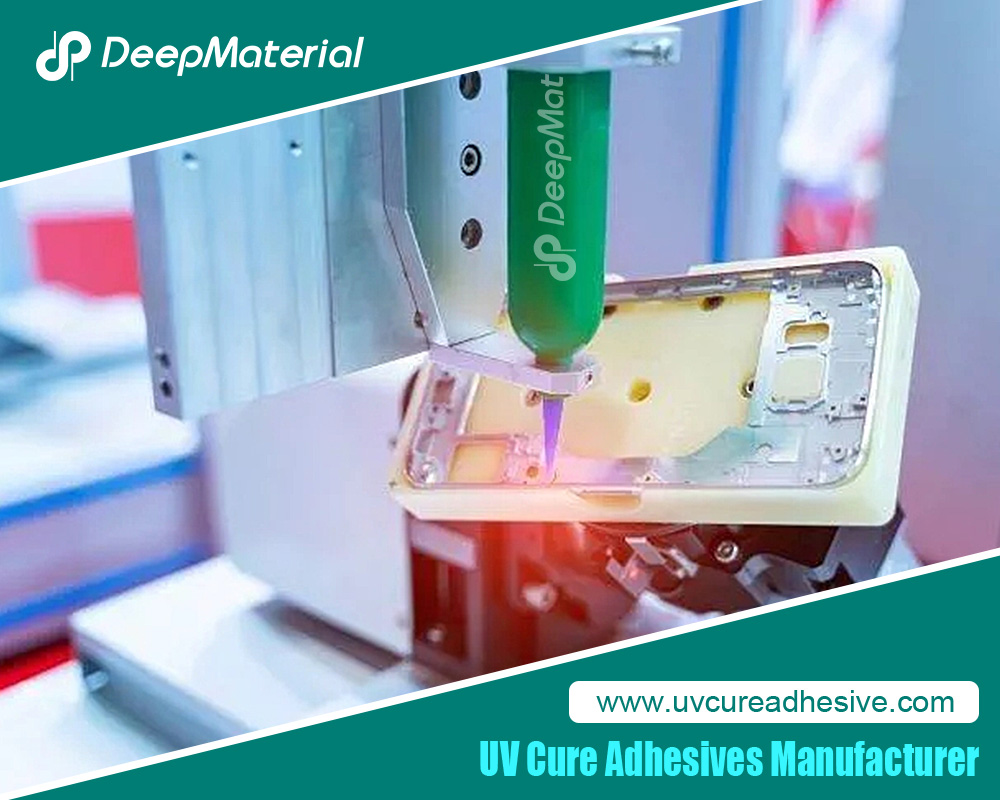
Process: Dispense 500 cP adhesive into 40 μm gaps between glass lenses and aluminum bezels. UV/LED flash (365 nm, 200 mW/cm², 5s) tacks for alignment; anaerobic cure (metal-activated) completes in 10 min at RT. Black pigment (OD=4) blocks internal reflections, boosting signal-to-noise 25%.
Results: Yield rose to 98.5%; shear strength hit 32 MPa post-1000 cycles (-40/150°C). Rework dropped 60%, saving $250K/year. FTIR verified 97% conversion, with no voids on SEM cross-sections.
This case underscores scalability: from prototypes to 10K/month production.
Implementation Best Practices
To harness this tech:
- Substrate Prep: Plasma etch for 70 mN/m wettability; ensure metal ions for anaerobic kickoff.
- Dispensing: Use needle valves for ±10 μm precision; thixotropy prevents stringing.
- Curing Setup: Match LED peaks (365 nm) to initiators; dose 1000-3000 mJ/cm². Monitor with radiometers.
- Testing: Validate via ASTM D1002 shear, IPC-TM-650 thermal shock. Use fluorescence for cure confirmation.
- Safety/Sustainability: UV shielding; recyclable packaging reduces carbon footprint 30%.
Troubleshoot: If anaerobic slows, add primers; for deeper blacks, layer cures.
Future Trends and Innovations
By 2030, expect AI-optimized formulations: sensors-embedded adhesives signaling cure via color shift. Visible-light extensions (400-450 nm) will penetrate deeper, aiding wearables. Nanofillers (e.g., graphene) could cut viscosity 50% for 10 μm gaps, while bio-based anaerobics target green manufacturing.
Quantum-dot pigments may enable tunable opacity for adaptive optics. In EVs, integration with 3D-printed housings promises seamless micro-seals.
Conclusion
UV + anaerobic dual-cure black technology redefines micro-gap bonding, turning shadows into strengths and gaps into unbreakable links. By marrying UV’s speed with anaerobic’s depth—and black’s precision control—it delivers robust, high-yield solutions for tomorrow’s devices. As challenges like 5G densification and AR immersion intensify, this adhesive stands as a pivotal enabler, slashing costs, boosting reliability, and accelerating innovation. For manufacturers, it’s time to go black: the future of bonding is dual, dark, and unbreakable.
For more about UV + anaerobic dual-cure black technology-how to solve the challenge of micro-gap bonding, you can pay a visit to DeepMaterial at https://www.uvcureadhesive.com/ for more info.